Contribute to Product UX Design News
Posting original articles or featured news recaps here requires registration and a published UX professional profile.
Once your profile is approved and published, you may submit articles for review.
Contact us with any questions. Thanks! 😊
Speculative cascades — A hybrid approach for smarter, faster LLM inference
We introduce “speculative cascades”, a new approach that improves LLM efficiency and computational costs by combining speculative decoding with standard cascades.

Smarter nucleic acid design with NucleoBench and AdaBeam
We developed an open-source software benchmark for nucleic acid sequence design, and introduced a novel algorithm, AdaBeam, that outperforms existing algorithms on 11 the 16 tasks, demonstrating …

Accelerating scientific discovery with AI-powered empirical software
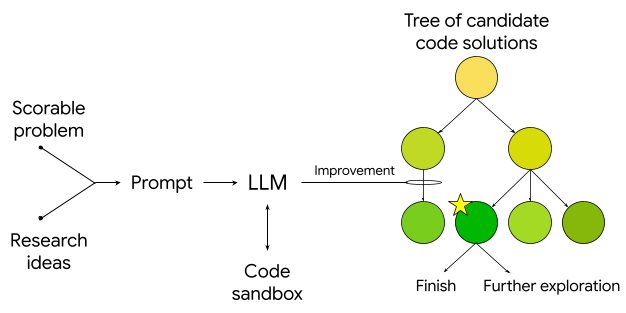
Our new AI system helps scientists write empirical software, achieving expert-level results on six diverse, challenging problems.
How Google’s AI can help transform health professions education
We explore the utility of Google’s AI models as helpful tools in medical learning environments. By employing a learner-centered and evaluation-driven approach, we seek to reimagine the future …

A scalable framework for evaluating health language models
Evaluation of language models in complex domains (such as health) can be expensive and labor intensive. We present a new adaptive and precise rubric methodology that saves time and increases …

From massive models to mobile magic: The tech behind YouTube real-time generative AI effects
We detail how YouTube delivers real-time generative AI effects on mobile devices by using knowledge distillation and on-device optimization with MediaPipe to overcome computational limitations …

Securing private data at scale with differentially private partition selection
We present novel algorithms to preserve user privacy in data releases, improving the state of the art in differentially private partition selection.

Beyond billion-parameter burdens: Unlocking data synthesis with a conditional generator
We present a novel privacy-preserving synthetic data generation algorithm that enables automatic topic-wise distribution matching, making it accessible even for resource-constrained AI …

Enabling physician-centered oversight for AMIE
We introduce guardrailed-AMIE (g-AMIE), a diagnostic AI designed for history-taking. g-AMIE operates with a guardrail that prohibits it from giving individualized medical advice, instead …

Achieving 10,000x training data reduction with high-fidelity labels
A new active learning method for curating high-quality data that reduces training data requirements for fine-tuning LLMs by orders of magnitude.

Insulin resistance prediction from wearables and routine blood biomarkers
Leveraging wearable data and routine blood tests, we propose a novel method for effectively predicting insulin resistance, providing a scalable and accessible approach for early type 2 diabetes …

Highly accurate genome polishing with DeepPolisher: Enhancing the foundation of genomic research
DeepPolisher, is a new deep learning tool that significantly improves the accuracy of genome assemblies by precisely correcting base-level errors, which recently played a key role in enhancing …

MLE-STAR: A state-of-the-art machine learning engineering agent
MLE-STAR is a state-of-the-art machine learning engineering agent capable of automating various machine learning tasks across diverse data modalities while achieving top performances.

Simulating large systems with Regression Language Models
We propose text-to-text regression with language models to solve all numeric prediction problems.

SensorLM: Learning the language of wearable sensors
We present SensorLM, a new family of sensor–language foundation models trained on 60 million hours of data, connecting multimodal wearable sensor signals to natural language for a deeper …

Synthetic and federated: Privacy-preserving domain adaptation with LLMs for mobile applications
Privacy-preserving synthetic data in federated learning can improve both small and large language models, with practical applications in Gboard to improve users’ typing experience.

An Holistic Framework for Shared Design Leadership
Picture this: You’re in a meeting room at your tech company, and two people are having what looks like the same conversation about the same design problem. One is talking about whether the …

LSM-2: Learning from incomplete wearable sensor data
We introduce LSM-2 with Adaptive and Inherited Masking (AIM), a novel self-supervised learning approach that learns directly from incomplete wearable sensor data, achieving strong performance …

Measuring heart rate with consumer ultra-wideband radar
Transfer learning enables contactless heart rate monitoring via ultra-wideband radar, paving the way for its deployment in everyday mobile electronic devices.

Android Earthquake Alerts: A global system for early warning
Using aggregated measurements from a global network of Android smartphones, we developed a system that detects earthquakes, delivers early warnings to users, and builds user trust with each …
